
Assessment Overview
Design and produce an original After Effects animation intended to elicit a specific emotional
response in a real audience, grounded in psychological theory, then test that response and analyse
what the data shows.

Blog
“The below reflective blog will explore the findings of psychological theory to understand why simple geometric motion reads as emotion and intention.”
Join the Discussion
Mood Adjustment Theory
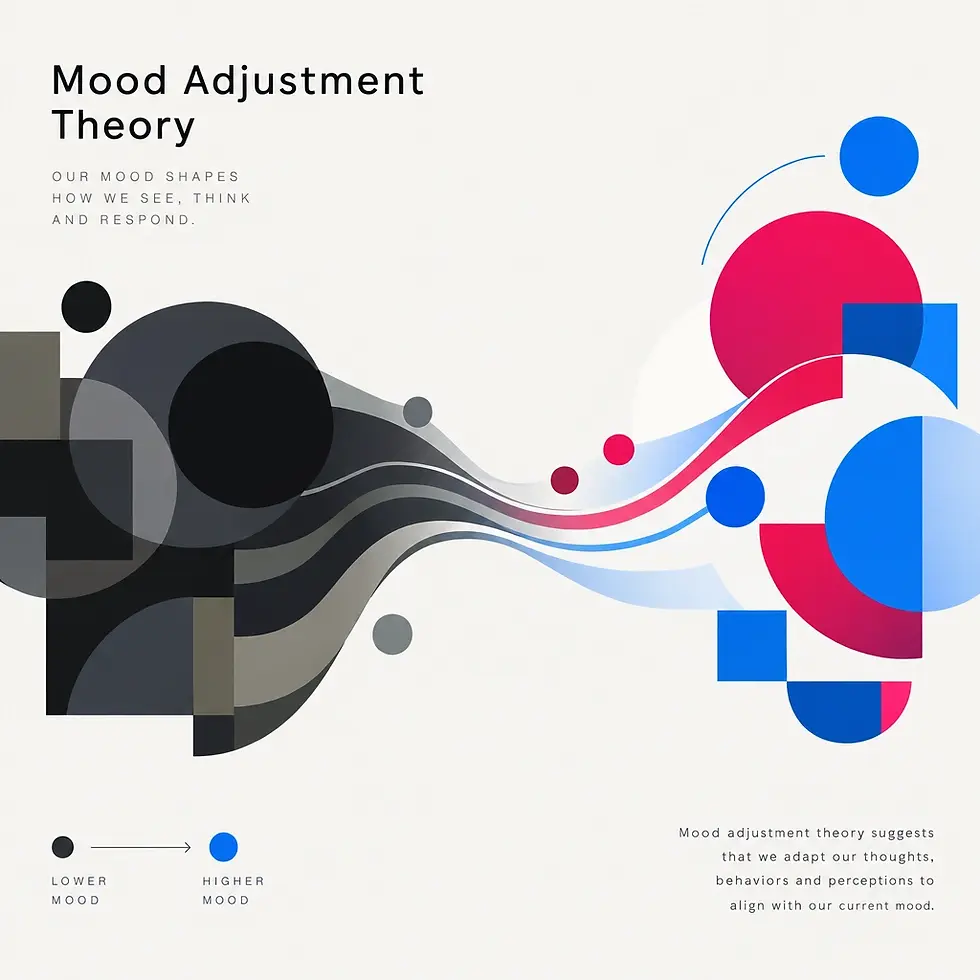
Developed in the 1980’s Dolf Zillmann’s Mood management theory suggests that people select media based on their affective states. Subconsciously selecting media that can help regulate their emotional states (MSc, 2025). Zillmann’s theory is founded on the basic assumption that people are motivated to alleviate negative emotions to preserve or intensify positive ones (Reinecke, 2017).
According to MSc (2025), mood management can be seen across various real-life interactions with media. With music described to support a person through a breakup, tv sitcoms described as a light-hearted distraction to a stressful situation or even social media described to provide online support through a tough situation.
With researchers then seen to diverge past the subconscious to the conscious giving us the mood adjustment theory. Where research states that the object of mood regulation then is not mood optimization but rather mood adjustment (Knobloch, 2003).
Taking a step back and looking closely at the initial premise of a subconscious decision and how this then can be transformed to intention. It opens the question to whether media can be used to influence people’s mood on purpose.
Hypothesis
If the theory states that people utilise media to influence their moods. Then can the mood management/mood adjustment theory be used to strategically manipulate the audiences moods through media.
"If people’s moods can be strategically altered through media, then visual media can be designed to guide viewers to a desired emotional state."
Building the Animation
To commence the process to test this hypothesis we start by selecting the desired emotions sadness & happiness. It was decided it would be best to select two emotions that were opposite to one another so we can establish a consistent emotion before testing whether we could transition viewers in to another emotion. By selecting opposing emotions, it also gave a clear distinction between the two, which would hopefully increase the success rate.
Once the emotions were selected I then dived deep into each. Exploring what it meant to feel sad and what is meant to feel happy. From this process I then established a mood board.

(Images sources through pintrest)
For sadness the key aspects that stood out were crying, rain, dark colours and isolation.

(Images sources through pintrest)
For happiness the key aspects that stood out were laughing, dancing, bouncing, groups and bright colours.
Following this I then spent some time watching basic geometrical animations for inspiration on how to approach my own design. The combination of research was successful, inspiring a little story in my head which formed the basis of the final animation seen.

(AniDong - 3D 애니메이션, 2016)

(Null, 2019)

(Joongwon Choi, 2015)

(Motion DIMA 2grd, 2017)
But wait we were not done yet. Before I commenced the animation process I took the time to reflect on our previous discussions. Looking closely at key theories discussed from Gestalt principle of similarity, the principal proximity & animation theories. I wanted to ensure the success of the animation by establishing which theories and animation techniques would be applied. From this I decided I would focus on the principal of proximity, the principle of similarity, animation principle of timing and the animation principle of follow through.
Principle of similarity
“According to research, (Lidwell et al., 2010, p. 226) the Gestalt principle of similarity asserts that elements that are seen to be similar are then perceived as a single group.”

(Lidwell et al.,2010)
Principle of Proximity
“According to Lidwell et al. (2010), elements that are close together are also perceived as a single group and are then also interpreted to be related. With Lidwell et al. (2026) stating that proximity is one of the most powerful means of indicating relatedness in design & will generally overwhelm competing visual cues.”

(Lidwell et al.,2010)
Once this was established the animation process could commence. I decided on a little story where my little circle was a tear falling and splashing on the ground. It was then followed by many more tears, but the first tear was left alone and isolated from the others. Then a little ray of sunshine falls, coming down to help the isolated tear and take them on a journey. The tear follows transforming the little tear into a tear of happiness and finishing by celebrating with a little dance of joy.

On conclusion of the animation, I was left thinking there was more needed. I did however conclude that making the design too complicated would conflict with the design requirements of the assessment. I also felt the test would not be successful and re visited the theory. I was left questioning whether this media type would inform the success rate of an experiment as I felt music would be better suited to influence emotions or at least visual media supported with music. Personally, I felt I could see the story but I couldn’t feel the emotions so I was intrigued how the survey would go.
Testing

When designing my survey I chose to incorporate a variety of question styles. I felt it was important to take the viewers on the journey again across the survey questions. Firstly, by establish the viewers emotional state, how or if the animation changed that then providing open ended questions to gain unadulterated feedback. Following which I steered the discussion towards people’s emotions but ensuring not to lead the responses and finishing up with pointed questions which targeted the happiness and sadness emotions. I also took the time to provide a variety of questions styles to keep things interesting and ensure viewers remained engaged. Whilst ensuring to keep the survey brief so people will finish the survey.


Our Findings
Survey
When analysing the answers from the survey, I found myself to be thoroughly entertained and surprised with the results. Overall, the engagement and responses were positive. With one person detailing the same story I saw when I created the animation. When comparing people’s emotional responses before and after watching the animation. There was a noticeable shift with people becoming more engaged and happier overall.
Core Findings
When looking at the open-ended question on what people saw, half the respondents told a story. These stories ultimately had a negative beginning with a happy energetic ending. Even the respondents who didn’t tell a story described a positive emotion for the ending of the animation sequence. Showcasing that 90% of those surveyed described a positive emotion. With 80% of respondent confirming they felt emotions and noticed a change to their emotions whilst watching the short animation.
When asking how the respondents felt after watching the animation however a surprising response was seen. With 60% advising they felt calm and ready to conduct a focused activity. Personally, I assumed that respondents would feel more energetic after experiencing positive and happy emotions. You can also see that the success rate of the happiness emotion was higher than the sad emotion. Interestingly the labels placed on the emotions varied and I would dare say understanding this would provide a lot more depth to the research moving forward. As respondents referred to the sad section as calm, anxiety or gloomy.
Unsurprisingly, respondents stated that the colour was the defining feature they felt influenced their responses, with the movement of the circles coming in second.
Summary
Overall, the experiment successfully proved the hypothesis, you can alter a persons emotions through media. As a majority of respondents confirmed they noticed an emotional shift and reported feeling happiness whilst watching the animation. With the only noticeable shift being the interpretation of the emotion and the story seen.